

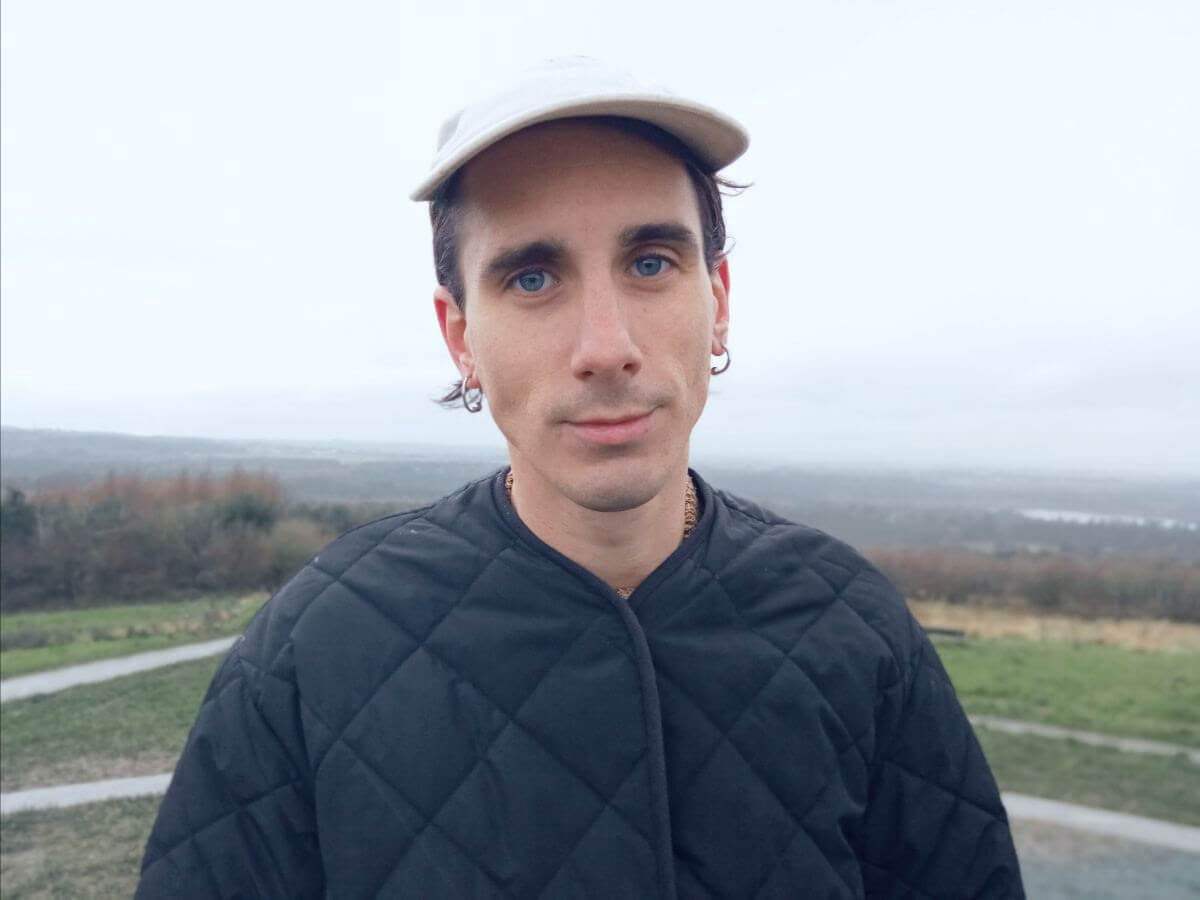
Dialect is the project of Liverpool-based artist Andrew PM Hunt. He has announced the release of a new album called Under~Between which will be out on March 19th via RVNG Intl. It is a collaboration with chamber music group Immix Ensemble. According to the press release, Dialect’s cross-pollination of acoustic and synthetic ensembles with human voice on Under~Between grows into a joyous ecosystem of delicate sound and intimate, unexpected melodies, yielding a strange yet delectable fruit.
Watch the new video for the track “Flame Not Stone” and check our chat with the artist who details the new album, the collaboration with Immix Ensemble, and much more below.
The album is a collaboration with Immix Ensemble, right? How did you start to collaborate for this new project?
I was asked to be their composer-in-residence for a series of concerts in 2018. I ended up writing a new piece of music for each concert they did that season and we were basically the opening act at each show. Growing up, my parents played in brass bands and so on, so the instruments (woodwind, brass, strings etc) were kind of familiar to me but I wouldn’t normally have access to them or those kind of players, so it was a really special opportunity. Me and Dan (the ensemble’s founder) spent many hours listening to all sorts of music together and I think he thought it’d be interesting to see how I combined my interest in electronics and ambient music with the sound of those instruments. I also ended up pulling in other musicians from Liverpool’s improvised music scene for the recording, so it become this kind of hybrid ensemble in the end.
“Under~Between“ is your new album. You said “I wanted to create something where there was a constant dialogue between the natural and technological, the mythical and the magical,”. What was the main focus when you started to compose this new work?
Whenever i’d hear orchestral music as a kid I always wondered why it wasn’t ‘produced’ like the pop records were. In some ways that’s the beauty of it but I wanted to find a more vivid setting for those instruments, which is what i did in the studio once the concerts were done. I was trying to create a playful ambiguous space between the digital side of my work and the acoustic sounds of the ensemble. There still seems to be a distinction made between the two approaches, but why? The saxophone was a cutting edge piece of music-tech at one point in history…
I worked pretty intuitively when composing, improvising melodies and then building arrangements around them, or working form a textural place and exploring similarities and connections. It’s important to me to embrace the aspects of music which are less easily reduced to words. In Western logic technology often appears to replace notions which were once magical and poetic, but i’m interested in giving them an equal footing. When it comes to making an album, over time you begin to see patterns in your instincts which give shape to a sensibility and narratives emerge from there.
With U~B, I wanted to hint at the co-dependance which I find so inspiring in the natural world as well as the limits of our knowledge and how precarious our understanding of the world can be. Sometimes all it takes is the sunlight to hit the room at a different angle and all of a sudden everything seems different- not just the room but our feelings, our memories, the next 10 minutes, the next 10 years…Our surroundings are transitory, our selves are transitory. What is real when everything is changing?
You have shared the video of the title-track and for the second excerpt “Flame Not Stone”. The visual part seems very important for this project, right? Can you tell us more about the two videos?
This record is born out of community really, both musically and visually. I’ve known Sara who made the video for U~B for a good few years now and really love her work. I think we share some kind of similar outlook maybe. Sara’s videos feel informed by a painterly instinct and likewise my music can be very ‘musical’ but ultimately there is something deeply psychedelic at the core of what we both do. That comes out in the way we see the natural landscape and the way we both embrace a kind of in-betweenness in our work. I think that a kind of malleability of perception might be a common thread we’re both toying with. The video for ‘Flame Not Stone’ was made by an old friend from Liverpool Sam Twidale and his partner Marija Avramovic who is also a painter. Their video riffs off of Sara’s in a wonderful way and also reflects conversations we’ve had about ecology and books like ‘Technic & Magic’ by Federico Campagna. They’re very interested in world building and narrative gaming, there is a playful and sweet aspect to their work which I really love.
Your album will be out via RVNG Intl, one of the few labels which tries to give space to different concepts and ideas of music. How much important is the work of a label like RVNG Intl. for your way of thinking music and for the contemporary music scene?
I feel very lucky to be working with RVNG. Their ability to create a context for pretty marginal work is really remarkable and I think it comes from Matt’s commitment to forging connections over time. We’d been talking for years before this record even started to take shape. That kind of sustained attention and interest is just really rare. Their whole vibe stems from kindness not coolness, which in the end is…pretty cool. They’re also not concerned with being a ‘genre label’ and that type of agnosticism suits me just fine 🙂
You are from Liverpool. I’m really interested in the connection between the places we live over the years, our roots and the art. How do you feel these themes connect to your music and your way of thinking music? What are your favourite places which have inspired you the most?
A sense of place has had a huge impact on my music over the years. Here in Liverpool there is such a strong countercultural pull- an outsider spirit, a constant psychedelic current, that is imbued in me deeply. It’s also cheap to live here which has a huge impact on how much time you have as an artist and therefore what type of work you can make. I would have struggled to make ‘Under~Between’ in London for instance. When I was in NYC it was the grimey post industrial wasteland of South Brooklyn which stirred something in me, I became enchanted. You begin to make these oblique, obsessive connections between locations in your mind which can only be explored through creative work. When I was making my last album ‘Loose Blooms’ I was simultaneously in the desert, above a nightclub and in the Scottish Highlands. With music you can go there.
Let’s talk about the current situation. How are you living these strange times and what are your main concerns for the music industry and the role of the artist?
Pre-pandemic I was making a living both as a performing musician and as a technician in art galleries. Both gigs and exhibitions obviously stopped pretty much instantly but i’ve been lucky to be supported by the government for most of the time, which was a bit like universal basic income…a strange thing to experience under a conservative government. I think as we emerge from covid it will be important to rethink our approach to travel and to concentrate on rebuilding our local networks so that scenes in smaller cities can thrive. As artists we have to imagine different ways of doing things.
During and after the lockdown time, Bandcamp was the only online platform which tried to help musicians, waiving their fees on the site on the very first Friday of the month. What do you think of this kind of initiative and how what is your idea about the rights of artist connected to streaming platforms?
I stopped using Spotify completely about 18 months ago and it massively improved my capacity to listen. I buy things on Bandcamp and play them off their app. It means I listen to less new releases but spend much longer with each release I buy, which feels really positive. You listen to an album in good faith, wanting to find what’s good about it, rather than casually scanning just to see what something is. As Mat Dryhurst has said many times, platforms like Spotify might work for big budget pop, but the model is irrelevant to deep scene music.
Ritual question. Have you seen or heard anything good recently?
Yeah i’ve been digging into Julius Hemphill’s back catalogue and really enjoying his stuff for saxophone quartet.


