

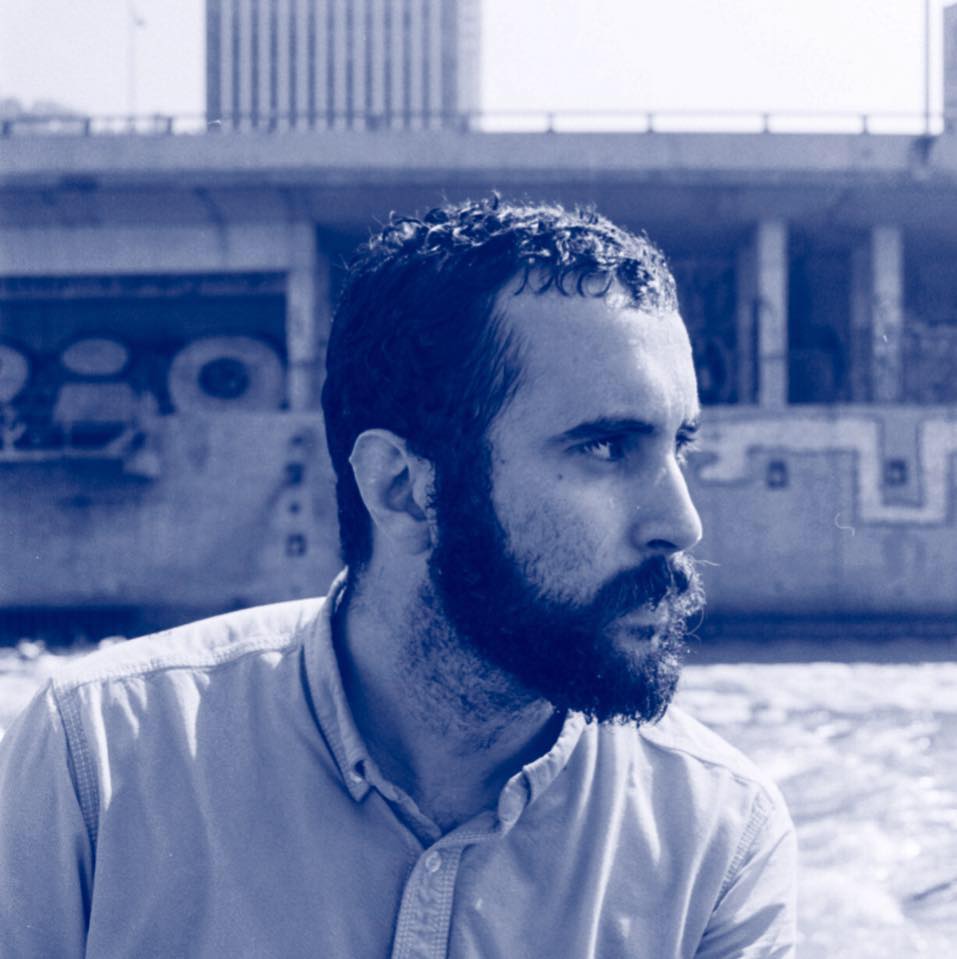
Two years ago we introduced Coliguacho, the project of Santiago-based musician and producer Ben Griffiths. The self-titled debut album was in our best albums list of 2018. He released a new EP called Migrations which is out now via Hush Hush Records. All proceeds for ‘Migrations’ via Bandcamp will be donated to the NAACP Legal Defense and Educational Fund, Inc.
According to the press release, While his adventurous and adaptable musical spirit has led to steady work composing music for documentaries as well as collaborations with some of Chile’s most exciting young pop artists, Coliguacho steps back into the forefront with ‘Migrations,’ a transportive 4-track EP that reveals new shades to his impressive sonic palette.
The origins of ‘Migrations’ date back to late 2015 when Benjamin was studying music as a college student in Melbourne. Inspired by the works of Hungarian-Austrian composer György Ligeti and Finnish composer Einojuhani Rautavaara, he wrote an original composition designed to mimic the sounds of migratory swallows through the impressionistic application of orchestral instruments. Performed with the help of his fellow classmates, the resulting recordings reveal a rich tapestry of ambient, jazz, and neo-classical styles that swoop, sway, bolt, and glide in dynamic fashion. Much like the profound, mysterious, and unpredictable beauty of birds flying in murmurations, the EP’s four movements offer elegant pastoral moments that build with the frenetic tension and precise energy of sublime controlled chaos.
Check our talk with the artist which explains the path of the new work and much more.
“Migrations” is your new work and it as inspired by the works of György Ligeti and Finnish composer Einojuhani Rautavaara. What aspects of their works drove your inspiration?
Hi! Thanks for getting in contact to have a chat.
Yeah! Ligeti and Rautavaara were big influences whilst writing “Migrations”. With Ligeti, I began getting interested in the textural nature of ‘spectral’ composition (Grisey, Murail, etc). Through that I arrived upon Ligeti’s “Atmosphères”. More so than the theoretical side of things (micropolyphany and so on), I found the use of the orchestra as almost diegetic sound very interesting. I think it was also the first piece by which I fully ‘bought into’ the concept of atonality. I’ve always been pretty diatonically inclined as a musician, but “Atmosphères” showed me a way to justify atonality to myself as a composer I guess.
With regards to Rautavaara, “Canticus Articus” (Concerto for Birds and Orchestra) is a piece I’ve oved for a long time, each movement individually and as an entire work. I remember when I was finishing school hearing it for the first time, and being initially obsessed with the use of tape recordings of birds in the second movement. The recordings work as a device that provided such a simple and recognisable sonic ‘foreground’ for the string arrangement to revolve around and create a world for those birds to inhabit. However, the real masterstroke for me in “Canticus Articus” is the third movement, the way Rautavaara manages to capture the movement and motions of a flock of birds is stunning. The portrayal of circular movement or three-dimensionality wasn’t something I’d ever previously experienced as a listener so intensely in western classical music. I think often we tend to experience music as something horizontal, particularly within the confines of orchestral music, and it makes sense. There’s a beginning and an end, a narrative that goes from left to write on paper as it does in time. The third movement somehow has a way of breaking and suspending that linearity. I also studied the sheet music and found a few tricks in the piece such as some extended instrumental techniques and textural writing that helps to so clearly animate the orderly chaos of the migrating swans in the third movement. Portraying such vivid imagery effectively is something I definitely wanted to challenge myself to achieve with Migrations.
“Migrations” is something different from your self-titled debut album and it reveals new shades of your sound. Is it right?
It is quite different to my first album, yeah. It was also recorded and composed in 2015, two years before I started working on Coliguacho. I think there’s a few things that make it quite different. One is that Migrations began as a uni project, with certain objectives and limitations as a result. The main purpose of that class was to experiment with the recording studio as a instrument in of itself, and we were given a specified amount time with a professional string quartet in the studio to basically do what we wanted. The other BIG difference between the two is that I don’t play a single note on an instrument in Migrations. I functioned only as composer, mixer and producer of the record, and yeah… didn’t play any of the instruments.
The Artwork is stunning and powerful. How did you choose it?
Thanks! The artwork is by Florencia Galecio (@galecioflorencia on IG). It was really pure chance that I found that photo. I had been chatting to Alex Ruder from Hush Hush Records, through whom I released Migrations (and Coliguacho, previously), and he’d just given the green light to putting this out when I started trawling through Instagram looking for a way to find some artwork or someone who could do something that would suit. I was recommended Florencia’s photography work by a friend of hers and eventually found the lovely black and white, grainy, photo of the birds. I knew immediately it was a match, and I got in contact.
You composed music for documentaries. Are you interested in doing soundtracks? What is your relationship with cinema and visual art?
I’ve been working with film and audiovisual content for quite a few years now, in fact it’s my main form of employment. I work closely with a few directors and production houses here in Chile as a composer and music producer. Most of the work I’ve done until now has been in a documentary style, which I love. However I’d also love to get more into composing for fiction and other forms of visual media. In recent times I’ve also started working with Estudio Prende, a production house here, as a creative producer aside from just the sonic side of things. Learning through that process and also being on set whilst filming I think has also made me a better composer. Being integrated in a project from beginning to end is very different to being only part of the post-production team.
You are from Chile, you studied in Melbourne. I’m very interested to the connection between the places we live over the years, the territorial geography of our roots and the art. How do you feel these theme connected to your music, your way to think music? What are your favorite places which inspired the most?
I’m actually more from Australia than Chile really, I grew up in Melbourne my whole life mostly. However, my mum and her side of my family is Chilean. I’d visited Chile growing up a number of times, but in early-2018 moved here for six months, and I never left. I always felt a strong connection to Chile growing up, because family dad’s side of the family is really small and my mum’s is huge… so it always felt like my family was almost all here. In Melbourne, and particularly my generation and social circles, it’s quite rare to have four grandparents born in the country. I think that multicultural nature of modern Australian society makes you, consciously or not, identify with your ‘other’… and mine was always Chile. Similarly, feeling ‘Australian’ isn’t an easy thing for many people to feel, and I don’t necessarily think that’s a bad thing. I‘ve never felt mainstream Eurocentric white Australia to have a unified or deep identity, and that in itself makes drawing creatively from that side of me something not necessarily natural. I guess that sensation only heightened my sense of Chile as a source of creative identity. It’s strange to talk about because it’s something I guess I’ve felt for a long time but never properly put into words. In terms of favourite places; the lake district in the south of Chile, where Patagonia begins, is magical. It’s one of my favourite places in the world, and I’ve often drawn from it creatively.
How are you living these strange times and what are the main concerns as an artist?
Well, Chile has been through a very tough yet inspiring 9 months. Covid-19 has hit hard here and exposed the massive inequality and under-resourced health system. It’s been tough to live through, but thankfully those close to me and I have been fortunate. Before the pandemic reached Chile, we had gone through what can be called a ‘social revolution’ starting in October, 2019. Although that came with some brutal suppression and blatant violation of human rights from the government, it also shone a light towards progress and has made a profound social and cultural impact on the country. Chile is a country with a tortured past, an often downtrodden yet persevering people, and a dictatorship still fresh in living memory. A lot of these wounds have been left bare by the pandemic, which has politicised the whole situation. This has all meant is pretty strict confinement since mid March. Its been quite difficult and challenging mentally. However, I’ve been very privileged to be able to confine myself safely and work remotely from my home, something many people here aren’t able to do. It has also allowed me to focus time on certain new projects. I released an EP with Ilmato & Jotar in April, a collaboration we made together each from our own home. Recently I’ve also begun working on a new project with my friend Camila as a duo called Ludoclub, which at some point this year we’ll be launching off the ground.
Ritual question. Have you seen or heard anything good recently?
Heaps! I’ve been listening to lots of Mid-Air Thief, Strongboi, Buscabulla and Khruangbin’s new albums, Andre Previn and Russ Freeman’s collab record ‘Double Play’, amongst other things. I’m also going through about the tenth Jai Paul-phase of my life. The most recent thing that I’ve been obsessing over is Chico Buarque and Ennio Morricone’s album, ‘Per un Pugno Di Samba’, produced by Sergio Bardotti. I never even knew existed until recently! Soon after Ennio pasted away last month, a friend showed me the album and since then I’ve been listening to it constantly. Wild production, simple songs, and some of Ennio’s more ‘out-there’ arrangements.


